Case Study / Fintech · Crypto Wallet
Send & Receive — Giving Yuh Users Real Ownership of Their Crypto
A self-initiated case study exploring how a Swiss neobank could let users send and receive crypto freely, without sacrificing the security of a regulated bank.

"What if Yuh users could send and receive crypto as freely as they trade it, without ever leaving the safety of their bank?"
The Shift
Yuh, the Swiss investing app from Swissquote and PostFinance, lets users buy and sell crypto with the simplicity of a banking app. But that's where it stops: crypto bought on Yuh stays locked inside Yuh. Users can't send it to a friend, get paid in crypto, or receive a token that isn't already listed on the platform.
For any real-world use of crypto, they have to leave Yuh entirely and set up an external wallet, trading away the exact simplicity that brought them to Yuh in the first place.
From a platform where crypto is bought and sold → to one where crypto can actually be owned and moved.
The Challenge
Integrate Send and Receive wallet functionality into Yuh's interface, giving users the flexibility of a self-custody wallet without compromising the security a regulated bank must guarantee.
- — How do you let someone receive crypto without handing them a private key to manage themselves?
- — What happens when a user receives a token Yuh doesn't support or price?
- — How do you introduce blockchain mechanics without breaking the trust of a banking-grade experience?
Moving from a platform that trades crypto to one that lets you actually own and move it.
My Role
Self-initiated project
This wasn't a professional engagement. It's a personal case study I designed as a Yuh user and amateur crypto investor, born from a real gap I kept running into in an app I use myself: I could buy crypto in seconds, but couldn't do anything with it afterwards.
What I did, end-to-end:
- check_circleproblem framing & research
- check_circlecompetitive benchmarking
- check_circleproduct architecture decisions
- check_circlecore flow design
- check_circleUI design
- check_circleUX copywriting
I decided to design the feature I wished existed, exactly as I would for a real product: research, architecture, flows, UI, and copy, all shaped as a Yuh user and amateur crypto investor, not as an insider.
The Strategy
Sending is the easy part. Receiving is where it breaks down: to receive crypto, you need an address of your own, and an address implies a private key someone has to hold. That question, not the send flow, became the real brief.
Benchmarking the market
MetaMask
Full self-custody, full flexibility, but the user carries all the risk, including the seed phrase itself.
Coinbase / Binance
Custodial and easy, but withdrawing back to your bank means leaving the platform's balance and waiting.
Revolut
Recently partnered with Trust Wallet rather than building self-custody in-house, outsourcing the hardest part of the problem instead of owning it.
Swissquote
Yuh's own infrastructure partner already runs native-blockchain send and receive, hot/cold custody, and address whitelisting, live and Swiss-regulated.
Swissquote matters most here, it isn't a competitor to benchmark from a distance, it's the bank Yuh's crypto infrastructure sits on top of. The hard problem, proving a Swiss-regulated custodian can offer real send-and-receive, is already solved at the group level. The open question is why that capability hasn't reached Yuh's much simpler, mobile-first audience.
Swissquote solved the custody problem. Yuh's job is to make it disappear behind an experience simple enough that you'd never guess how much regulation sits underneath.
The architecture: inheriting the group's infrastructure, not inventing one
Because Swissquote already operates Swiss-regulated custody at the group level, Yuh doesn't need to solve custody from zero, it needs to design the layer that makes an existing, proven capability feel native to a much simpler product. The model below mirrors the same pattern large exchanges use internally, a unique deposit address per user, swept periodically into custody, and is consistent with what the group has already validated works within Swiss banking law.
- arrow_rightYuh generates a personal wallet address for each user and stores its seed phrase on an offline server, never exposed to the user
- arrow_rightSending goes through Yuh's own wallet, as simply as a bank transfer
- arrow_rightReceiving a supported token lands on the personal address and is automatically swept into Yuh's wallet, priced and usable like any other Yuh asset
- arrow_rightReceiving an unsupported token stays on the personal address. Yuh can't price it or vouch for it, but the user can still see it and send it onward, "at your own risk," rather than having it disappear into a dead end
A wallet with the DNA of a bank account: what you sell becomes spendable money, not a balance stuck on someone else's platform.
Risk: turning Yuh into a cash-out shortcut
Yuh's buy and sell fees are higher than low-cost exchanges like Kraken. A rational user could buy elsewhere at a lower fee, transfer into Yuh purely to receive, then sell on Yuh for the instant fiat convenience, using Yuh as a cash-out ramp rather than a trading platform. Left unaddressed, this risks eroding trading revenue on exactly the users the feature was meant to serve.
Rebalance buy/sell fees
Lower buy fees, raise sell fees to nudge people back toward buying on Yuh. Trade-off: penalizes long-term holders who eventually sell, not just arbitrageurs.
Fee on receiving
A small fee on receiving external crypto targets the actual behavior directly. Trade-off: risks feeling like a tax on the headline feature itself.
Leave pricing untouched
If added activity and retention outweigh the fee gap, this might be a non-issue, worth validating with real usage data first.
I didn't settle on one answer here. It's a pricing and business-model question as much as a design one, flagged as an open trade-off rather than a solved problem.
Execution
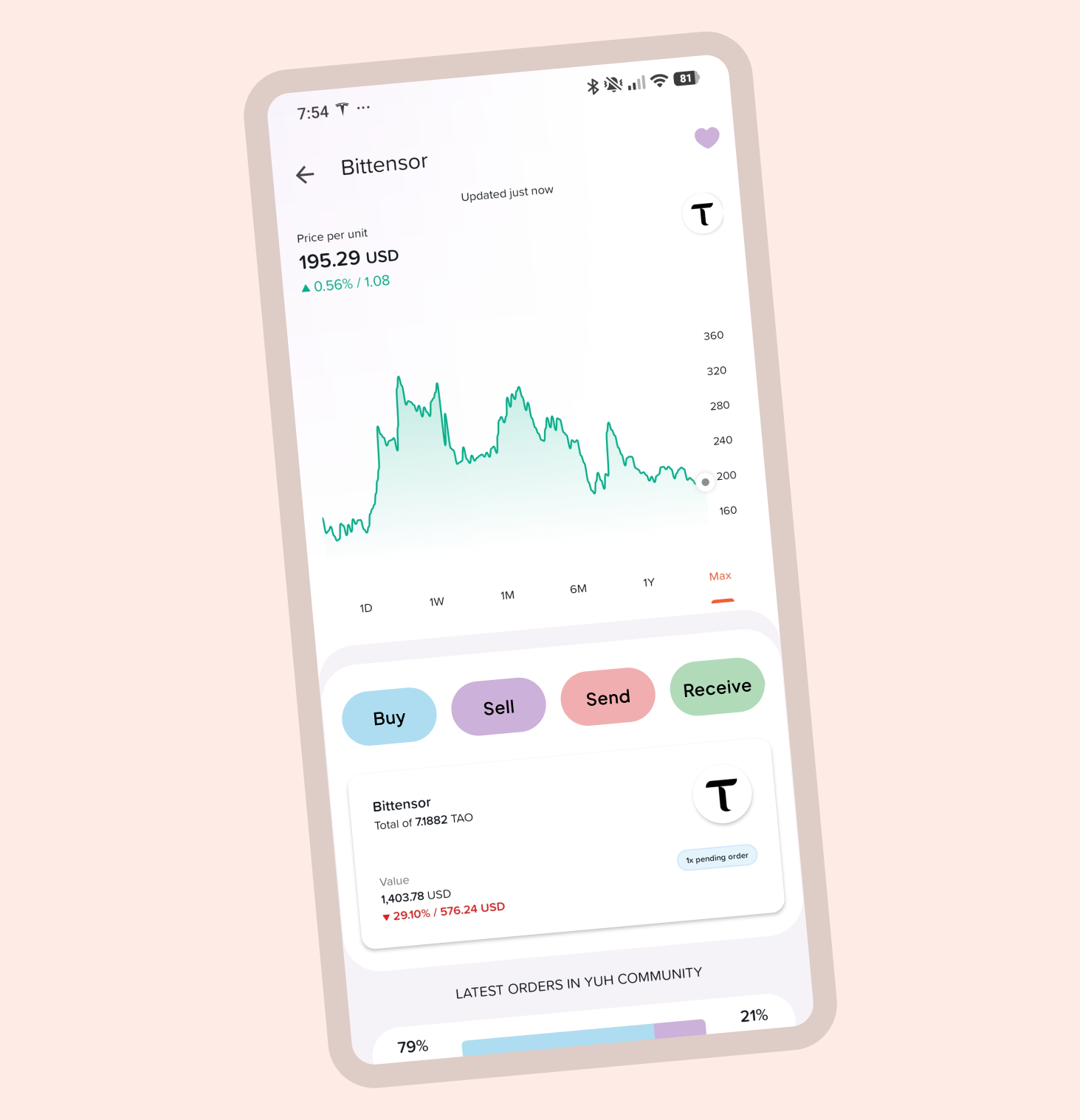
A full wallet covers swaps, staking, dApp connections, NFTs. I deliberately scoped this to Send, Receive, and the security layer around them, keeping Swap and dApp connectivity as clearly labelled next steps.
Staying inside Yuh's existing design language
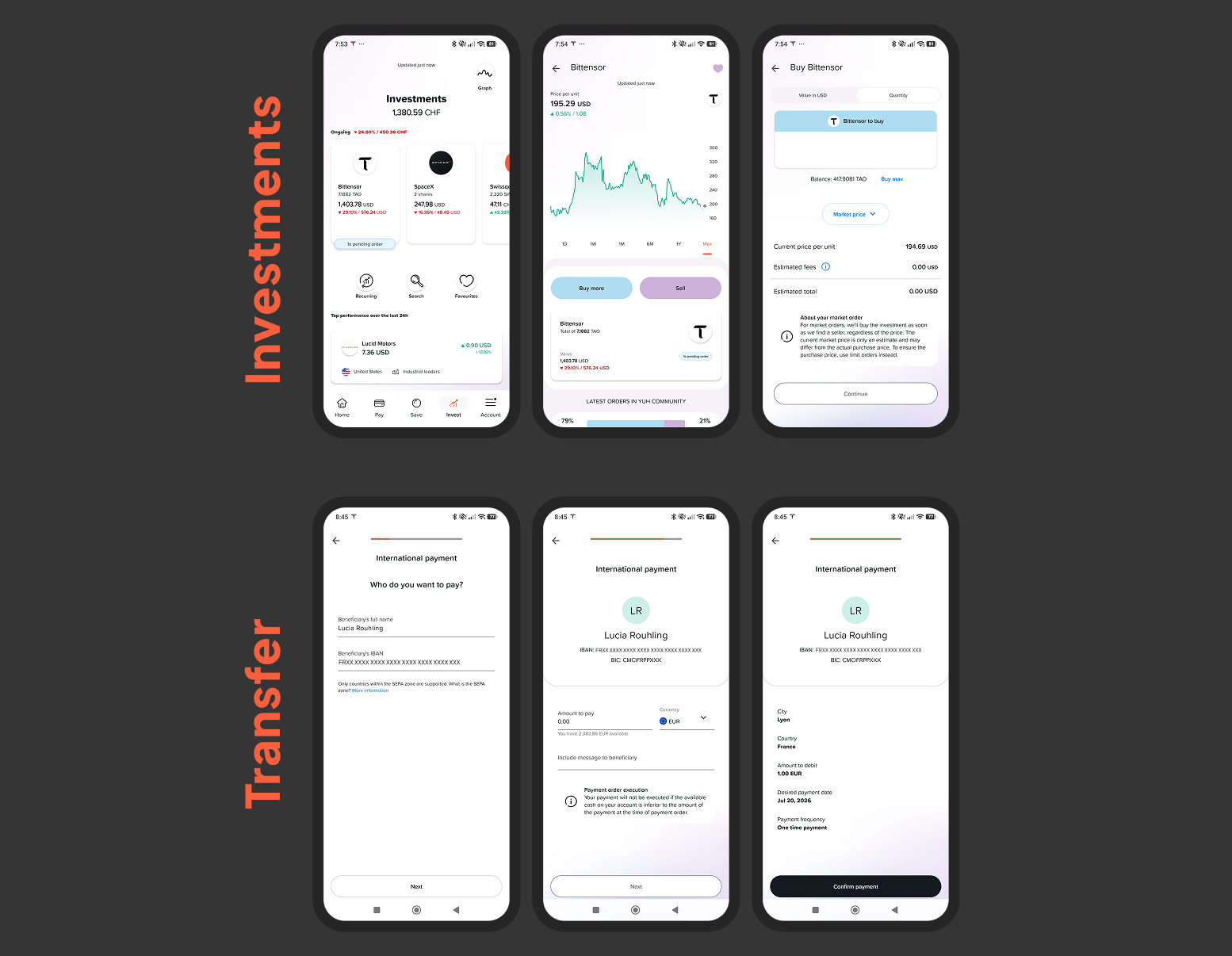
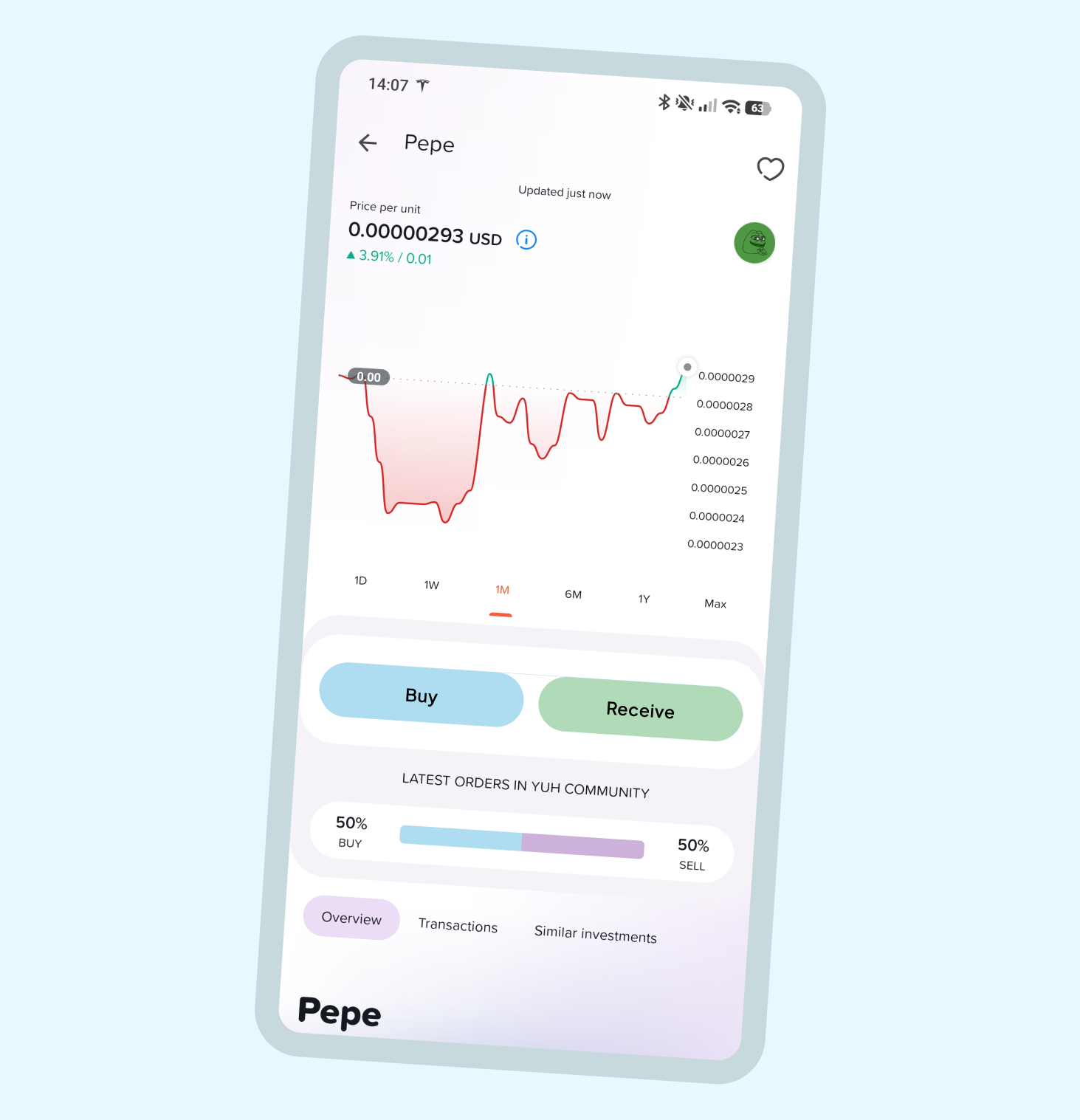
Rather than inventing a new visual pattern for crypto movements, I deliberately mined Yuh's own Transfers and Investments flows for structure and layout. Amount entry, confirmation steps, recap screens, even the biometric confirmation moment already exist elsewhere in the app in a form users trust.
This kept Send and Receive visually and behaviorally consistent with screens people already use to move money or buy securities, lowering the learning curve for a feature that's inherently unfamiliar to most banking users.
Surfacing crypto movements in Activity
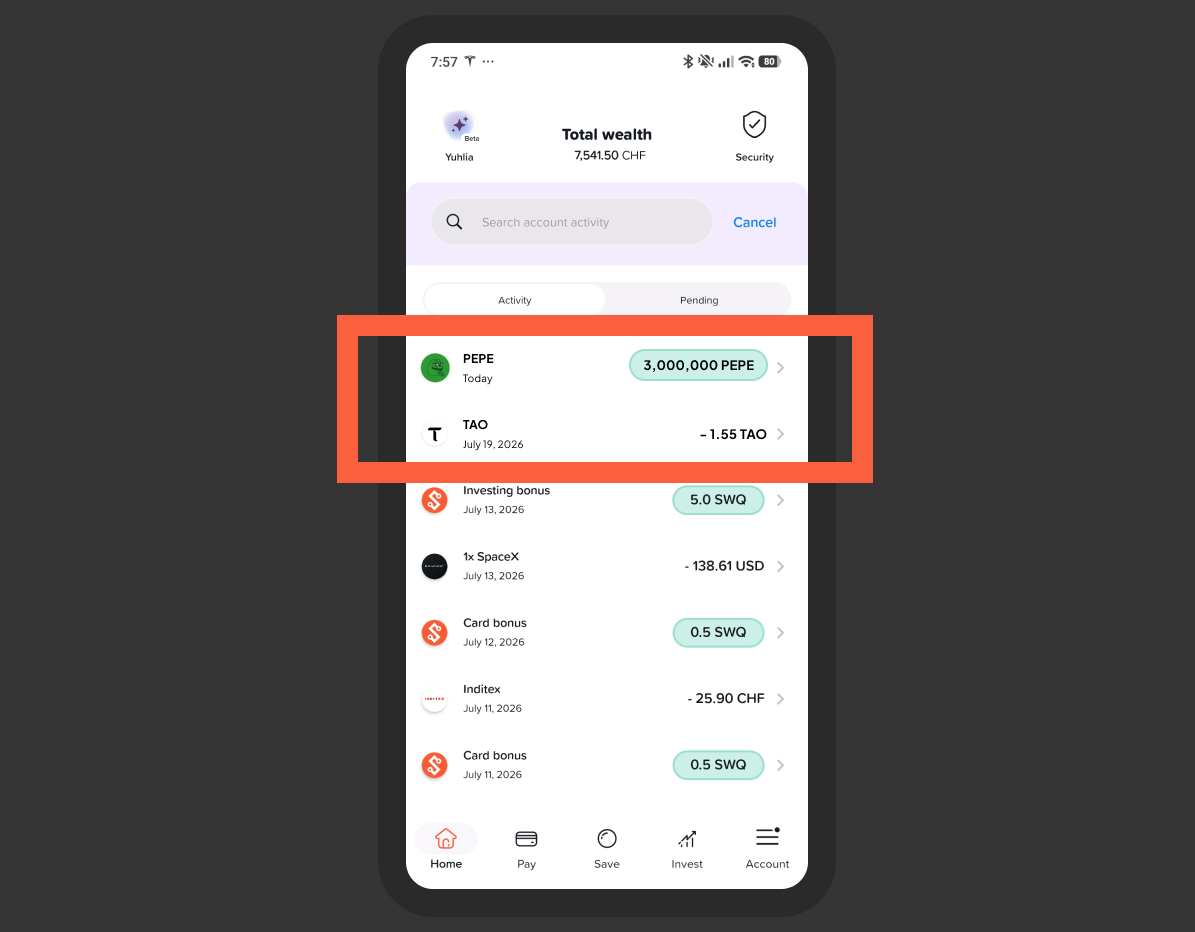
Send and Receive needed to live somewhere users already look for their transaction history. I integrated both new movement types directly into the existing Activity screen, alongside transfers, card payments, and trades, rather than creating a separate crypto-only ledger. A received or sent crypto transaction shows up exactly where a bank transfer would, keeping one single source of truth for "what happened to my money," regardless of whether it happened in fiat or crypto.
Designing the announcement moment
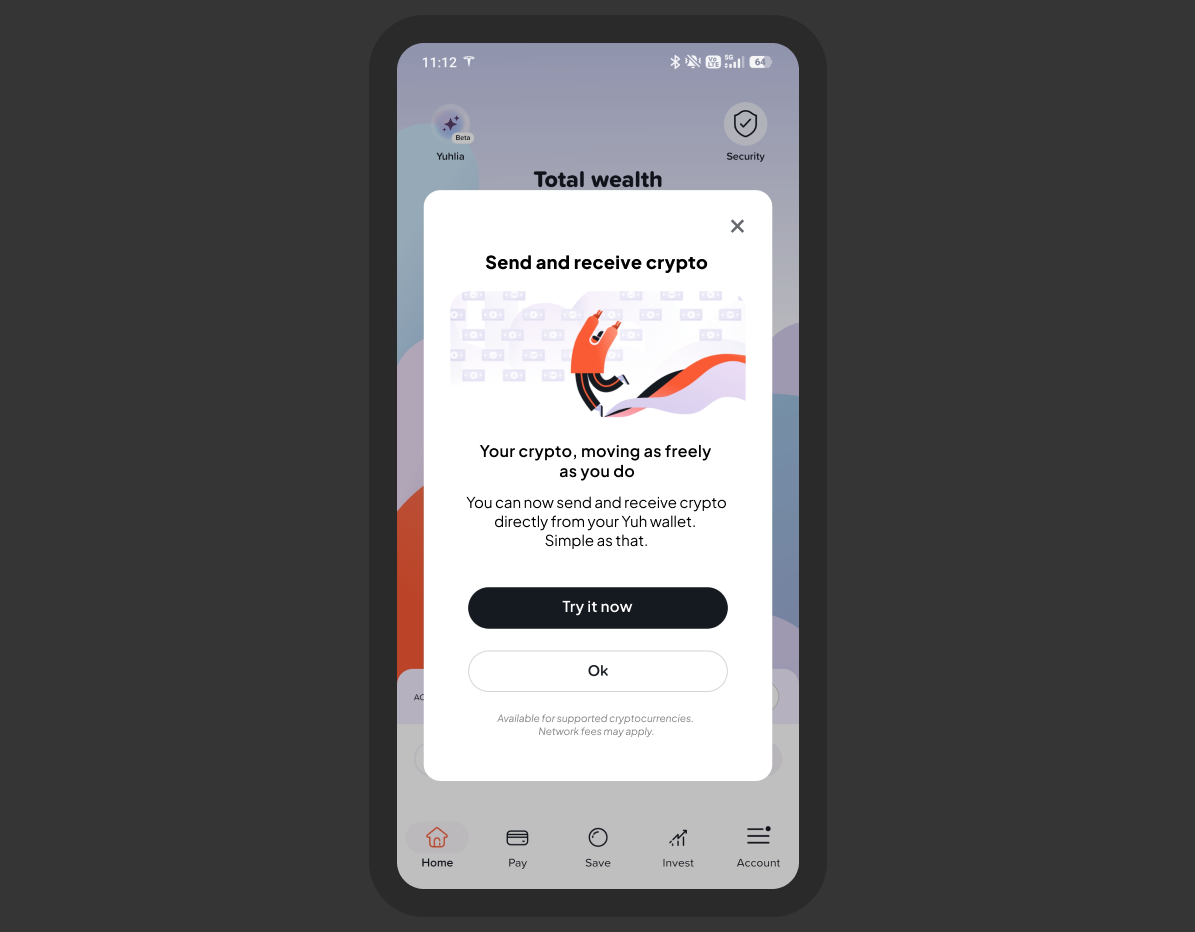
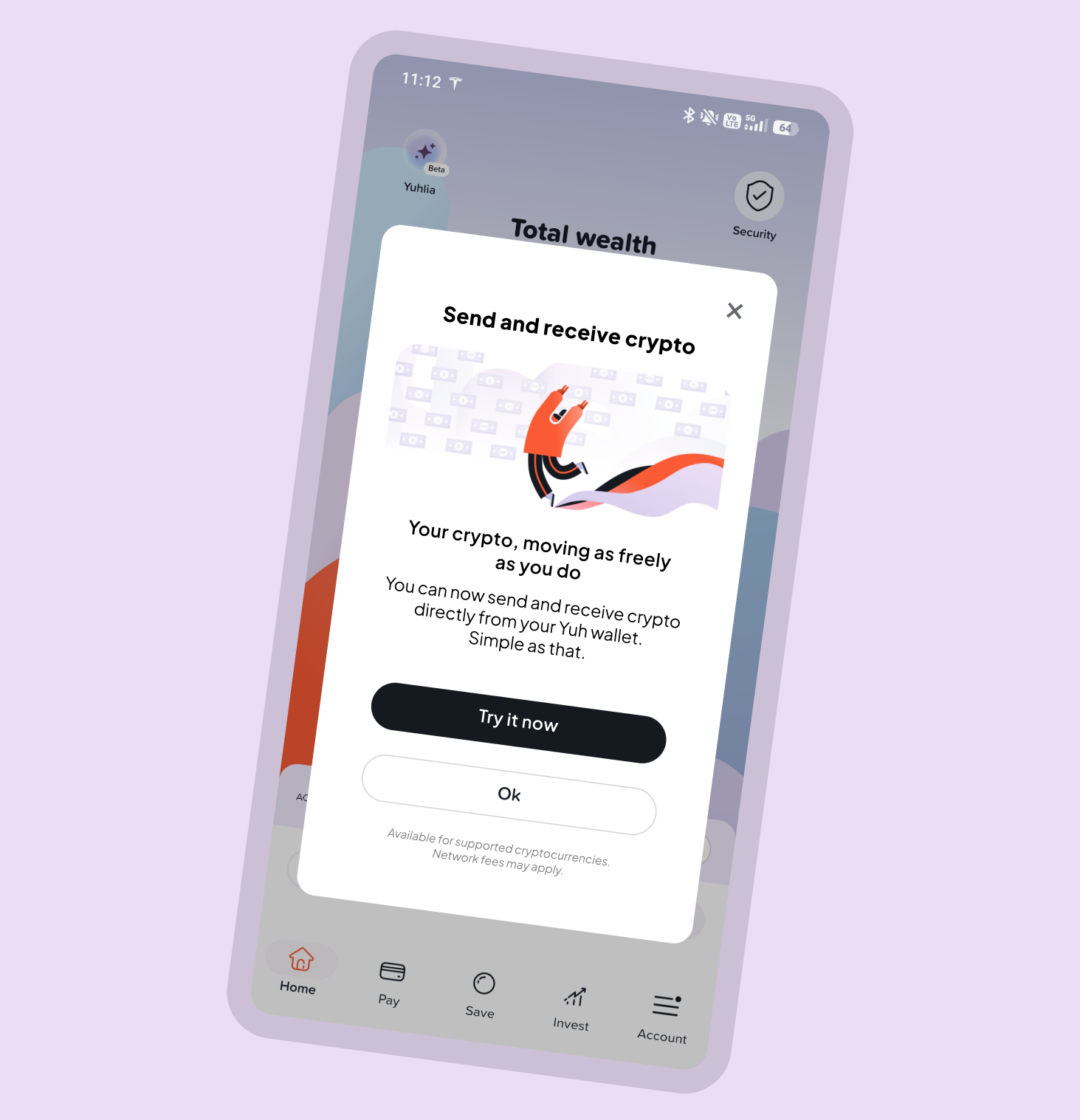
Before anyone touches the feature, they need to know it exists and trust it. I designed the in-app announcement modal in Yuh's existing promotional format: illustration, short headline, primary and secondary CTA, fine-print disclaimer.
Titles moved from feature-first to more emotional framings ("Your crypto, moving as freely as you do") before landing on a direction matching Yuh's confident, friendly tone without overselling it. The CTA went through the same scrutiny: does it promise an action, or an exploration? The answer depended on exactly where the tap would land.
Core flows
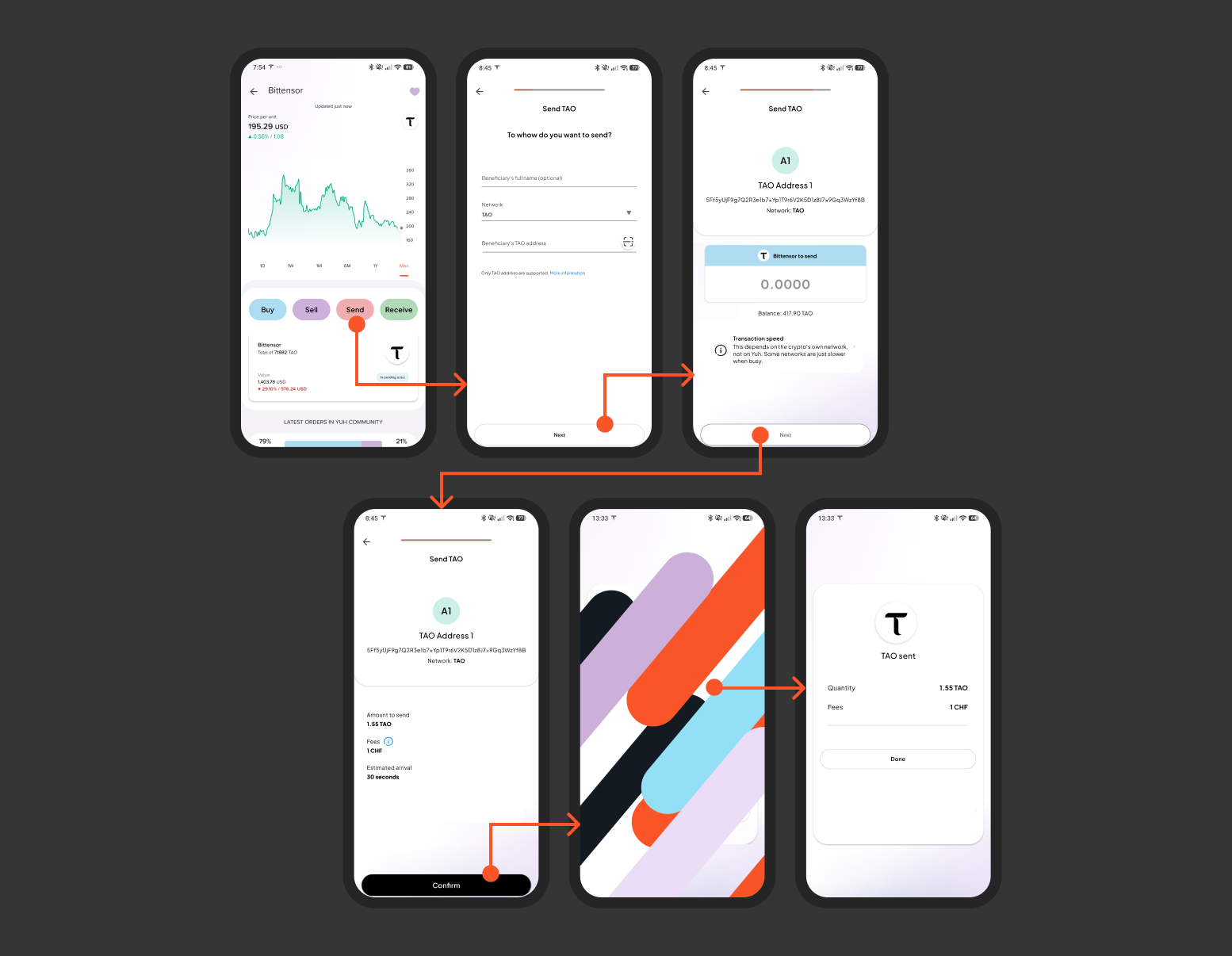
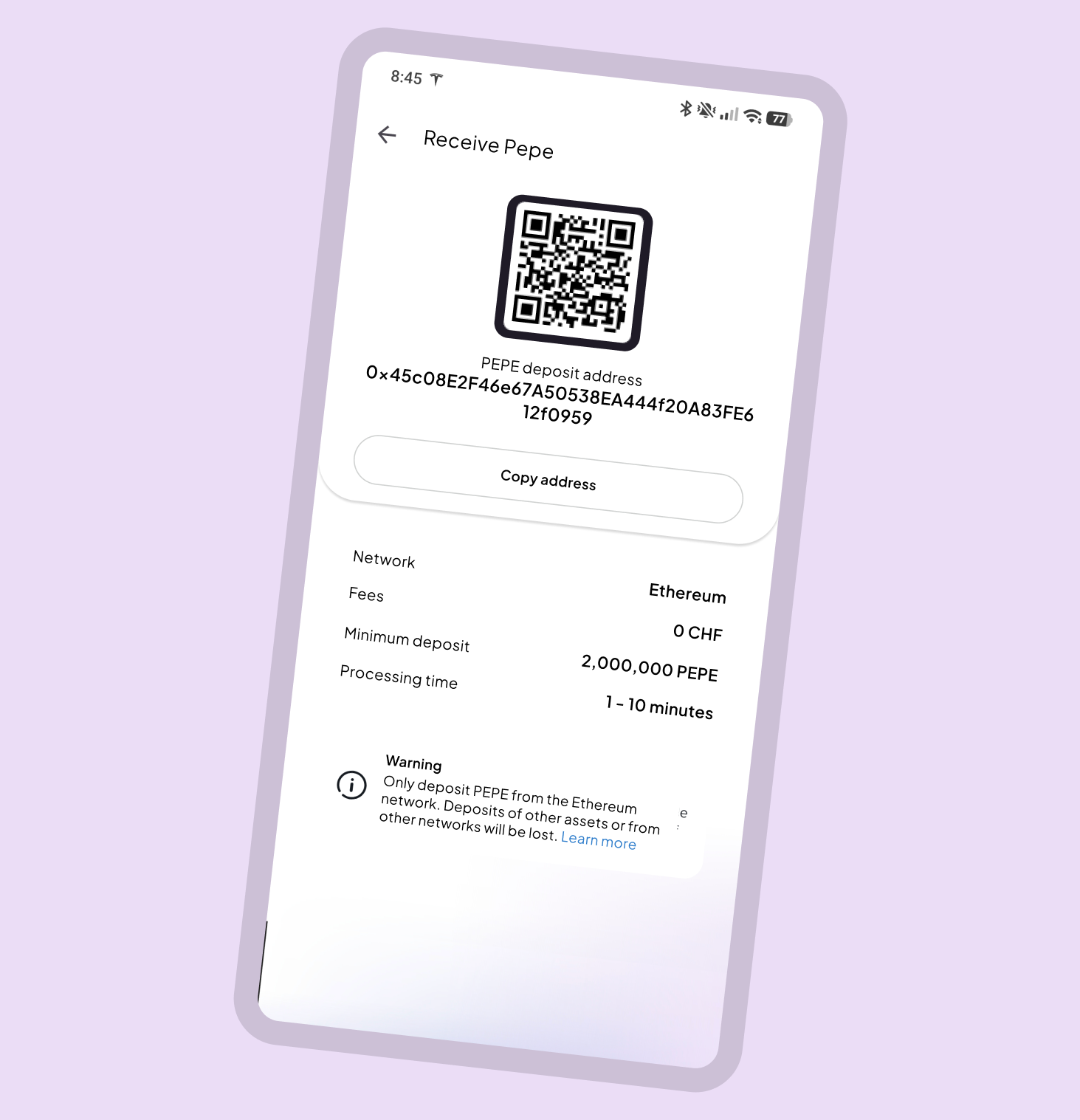
Two flows, two different UX weights. Send needed to feel as reassuring as a bank transfer. Receive needed to make an unfamiliar concept, a personal blockchain address, legible at a glance.
Swissquote protects its transfers with address whitelisting: a destination has to be pre-approved before you can send to it. I deliberately kept Yuh's Send flow closer to a standard bank transfer confirmation instead of adding that extra step, Yuh's audience isn't Swissquote's active traders, it's people who want crypto to feel as simple as the rest of their banking. Less upfront friction against a stricter security gate: a real trade-off, made on purpose rather than overlooked.
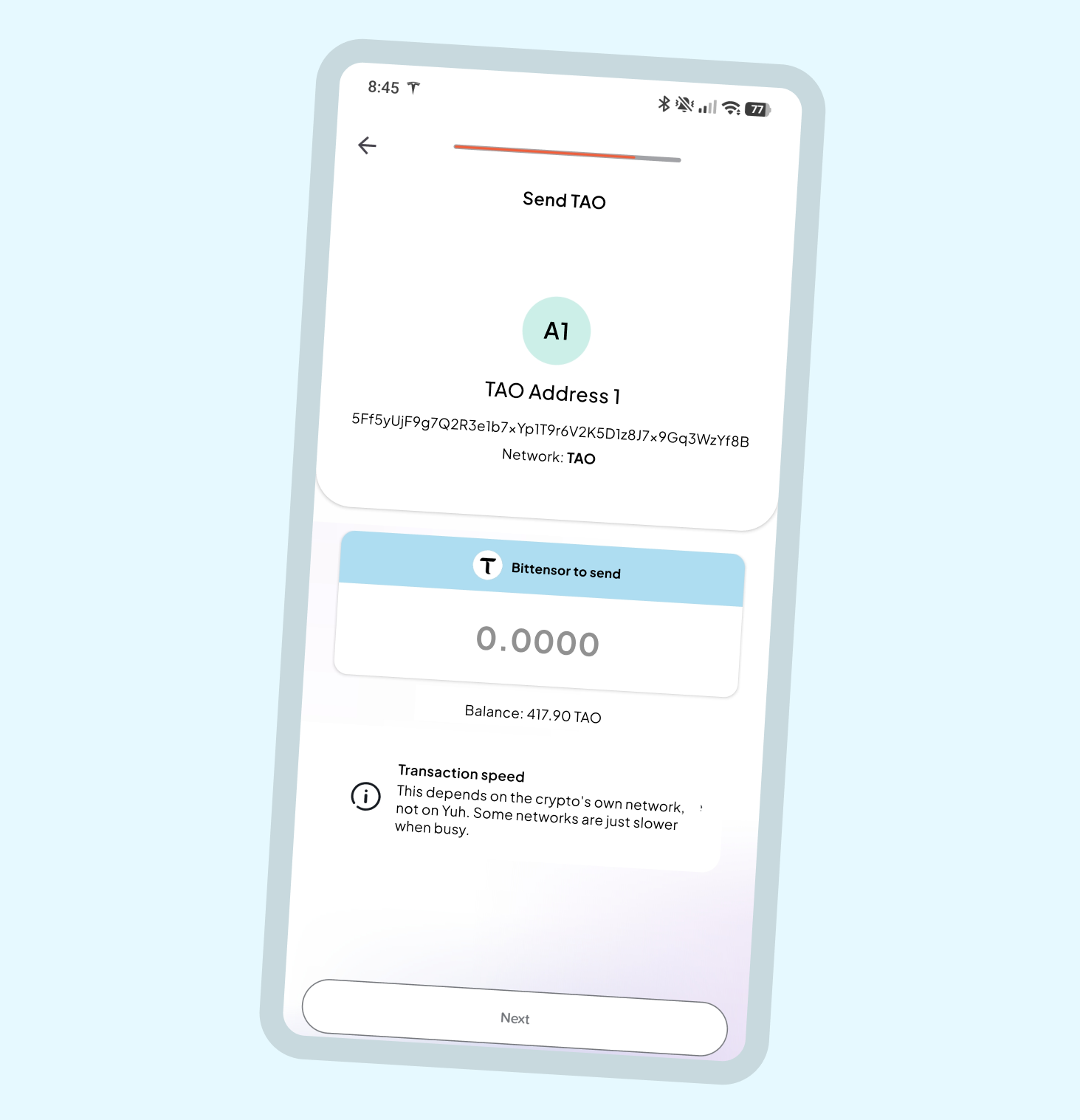
Send
Modeled on Yuh's transfer flow: pick the crypto, scan or paste an address, confirm, biometric sign-off.
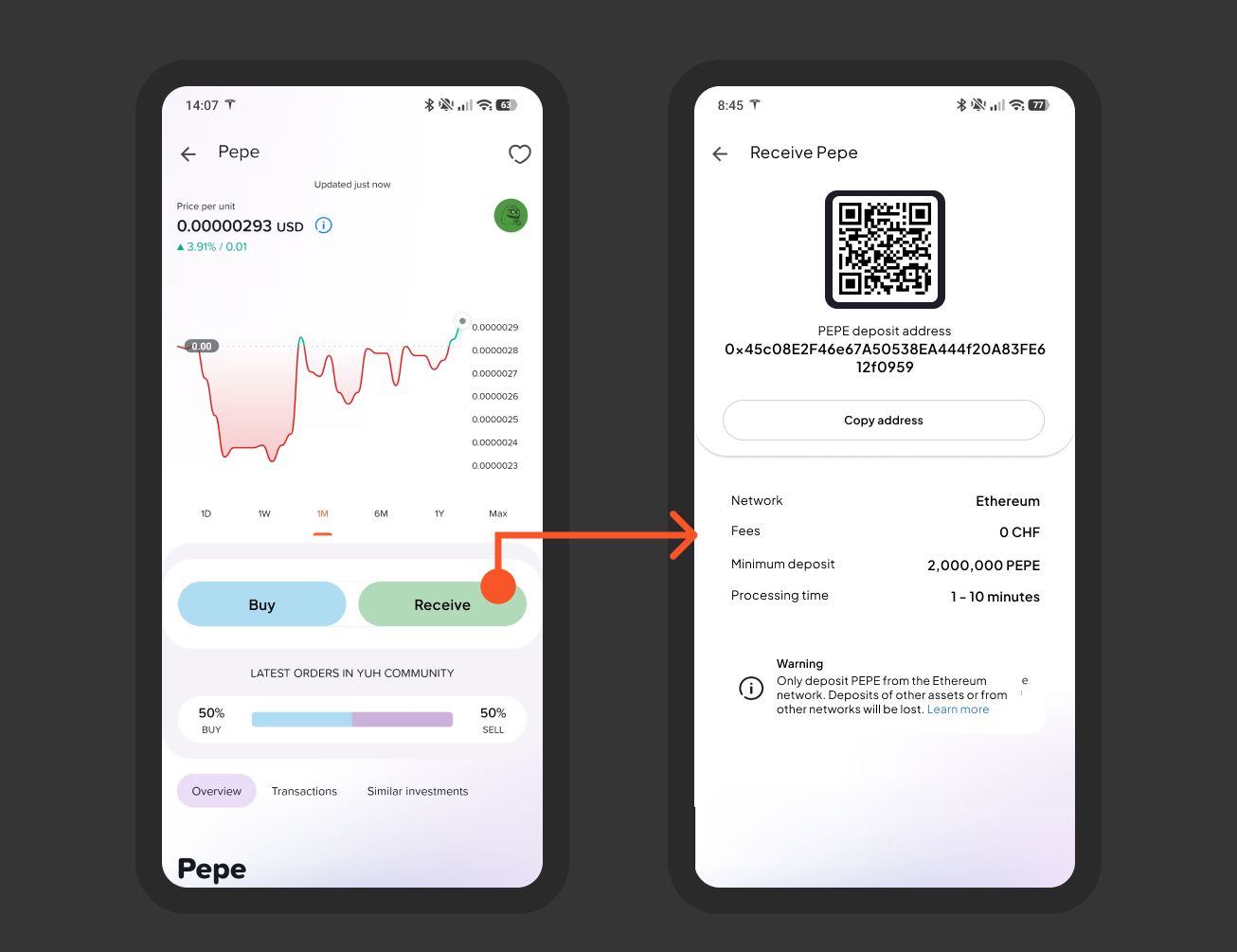
Receive
A personal address surfaced as a QR code, with clear network guidance and an estimated arrival time.
Gallery

Outcomes & Impact
Benchmarked against MetaMask, Coinbase, Revolut, and Swissquote, revealing that the real problem was product translation, not technical invention
A custody approach that leans on infrastructure already proven at the group level, adapted into a simpler experience for Yuh's own audience
A differentiated value proposition vs. every crypto exchange: selling crypto returns real, spendable money instantly
Deliberate design restraint: every screen built on Yuh's existing Transfers and Investments patterns rather than a new visual language, so an unfamiliar feature still feels safe
End-to-end UI copy, written and iterated screen by screen, in the brand's own voice
An identified business-model risk (fee arbitrage via external cash-out) flagged with concrete pricing directions
Reflection
The real challenge here was staying inside Yuh's existing design language. It would have been easy to design a more "crypto-native" wallet experience but consistency is what makes an unfamiliar feature feel safe.
Even if Swissquote had already solved the hard technical problem, digging into the benchmark was genuinely fun. It also reframed the brief to "translate something that already works for traders into something simple enough for everyone else," which is more aligned with Yuh's primary goals.
This was never a professional engagement, just a personal itch I designed my way through as a Yuh user. It didn't need to be serious to be worth doing properly.